












Last Updated: October 28, 2026
Quick Summary
You can alter a plus size dress for a better fit by taking in side seams and darts, or letting seams out where allowance exists. Most ready-to-wear dresses carry 1/2 to 1 inch inside each seam, roughly 2 to 4 inches total across the body. When no allowance remains, add fabric panels instead.
- Measure your bust, waist, and hips against your body in thin clothing, writing each number down twice.
- Take in side seams and darts rather than the center back to keep the dress balanced and grain line straight.
- Leave at least 5/8 inch of seam allowance so the dress can be let out later.
- Take in a dress at the waist using two vertical back darts rather than a horizontal seam.
- Stop altering when the fix would cost more than a new dress or no seam allowance is left.
Table of Contents
- Start With Accurate Body Measurements for a Plus Size Dress
- How to Make a Big Dress Fit Better: Take In Side Seams and Darts
- How to Take In a Dress at the Waist Without Ruining the Drape
- Can a Seamstress Make a Dress Bigger? Letting Out and Adding Fabric
- How to Alter a Dress for a Larger Bust: Cups, Darts, and Neckline Fixes
- Fabric, Lining, and Seam Allowance: What Plus Size Dresses Allow
- Fit and Comfort Checks Before You Sew
- When to Stop Altering and Shop a Dress That Fits
- Frequently Asked Questions
Start With Accurate Body Measurements for a Plus Size Dress
A plus size dress only fits as well as the numbers you start with. Most fit problems trace back to measuring over clothes or guessing. This guide puts measurements first and sewing second.
Body measurements are taken against your body with a soft tape, not against an old dress. Measure in thin clothing or a shaping layer, and write each number down twice to compare.
How to Measure Bust, Waist, and Hips
- Bust: Wrap the tape around the fullest part of your chest, level across your back. Keep it snug, not tight.
- Waist: Find your natural waist by bending sideways. The crease is your waistline. Measure there, not at your navel.
- Hips: Measure around the fullest part of your hips and lower abdomen, usually 7 to 9 inches below the waist.
A shaping bodysuit gives you a truer base number. The Full Size Under Bust Shaping Bodysuit 1 is built for exactly that, put it on before you pick up the tape.
How to Make a Big Dress Fit Better: Take In Side Seams and Darts
To make a big dress fit better, take in the side seams and darts rather than the center back. That removes fabric evenly on both sides, keeping the dress balanced and the grain line straight.
Here is the fitting sequence that works for plus size dress alterations:
- Turn the dress inside out and put it on.
- Pin the excess along each side seam, starting at the bust and working down.
- Pin any gaping at the back darts.
- Take the dress off and mark every pin with chalk.
- Baste the new seam line by hand before you sew it permanently.
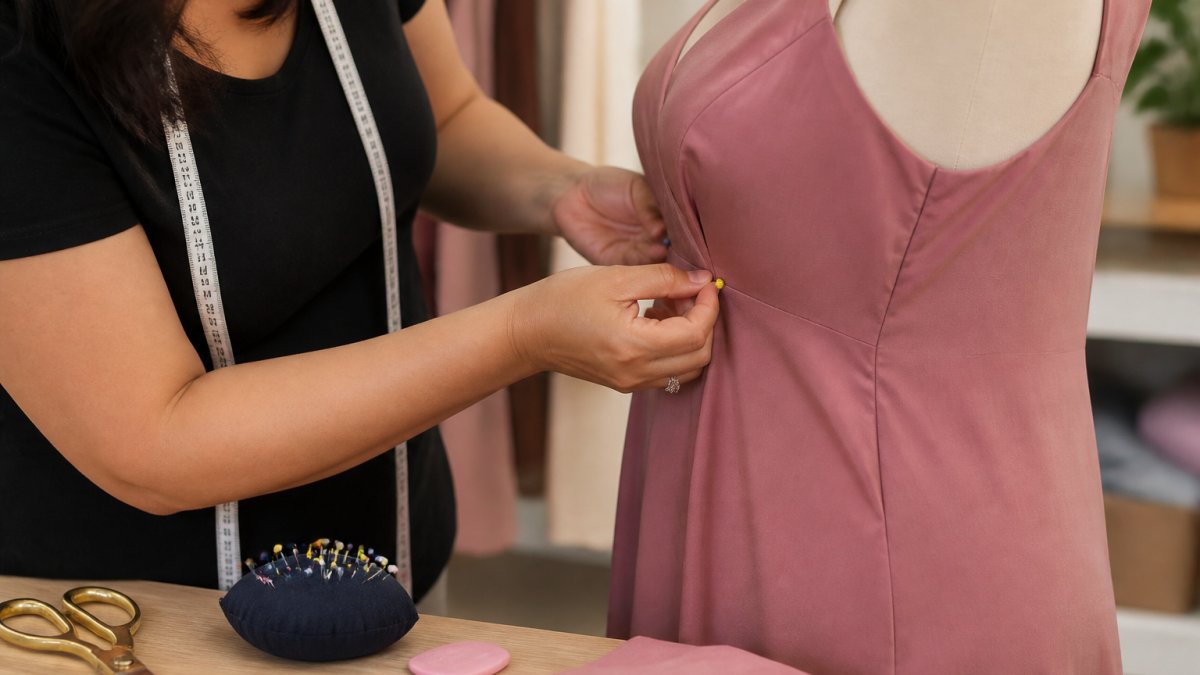
Step-by-Step: Pinning and Sewing Side Seams
- Pin from the underarm down to the hem, keeping the pins parallel to the seam.
- Leave at least 5/8 inch of seam allowance so the dress can be let out later.
- Baste, try on, then adjust before the final stitch.
How to Take In a Dress at the Waist Without Ruining the Drape
Taking in a dress at the waist works best from the inside, using two vertical back darts rather than a horizontal seam. A horizontal tuck shortens the bodice and pulls the skirt up; back darts remove width without changing length or drape.
Can a Seamstress Make a Dress Bigger? Letting Out and Adding Fabric
Yes, a seamstress can make a dress bigger, but only as far as the seam allowance and construction allow. Most ready-to-wear dresses carry 1/2 to 1 inch inside each seam, roughly 2 to 4 inches total across the body. Princess-seamed styles give you four or more seams, making them the easiest plus size dresses to let out.
Do the Seam-Allowance Math Before You Pick Up a Seam Ripper
Measure the seam allowance at the side seam, center back, and any princess or waist seam, then do the math:
- Side seams: each can give up about half its allowance. A 1-inch allowance yields roughly 1/2 inch per side, or about 1 inch total.
- Center back: a 1-inch allowance yields about 1 inch of extra circumference, but only if the zipper or placket has a facing you can move.
- Princess seams: four seams at 1/2 inch each yield about 2 inches total, and follow the body's curves better than side seams.
If the total comes up short, plan for panels instead of seams. Forcing a seam past its allowance leaves a raw edge and a weak stitch line that will pull out.
Step-by-Step: Letting Out a Side Seam
- Turn the dress inside out and find the existing stitch line.
- Use a seam ripper to remove the stitch line only, do not cut the fabric.
- Press the seam allowance open to see how much fabric you actually have.
- Pin the new seam line 1/8 to 1/4 inch inside the old one, tapering to nothing at the underarm and hip so the seam does not kink.
- Baste by hand, try the dress on inside out, and check the fit.
- Sew with a 2.5 mm stitch length and matching thread; press the new seam open.
When to Let Out vs. Add Fabric Panels
| Situation | Best Fix | What It Buys You |
|---|---|---|
| Dress is snug at the side seams | Let out the seam allowance | Up to about 1 inch per seam pair |
| Dress is tight across the back | Let out the center back seam | A little extra room, no visual change |
| Dress will not close at all | Add side or back panels | As much room as the panel provides |
| Dress is tight in the bust only | Add a gusset or change the cups | Room where you need it |
| No seam allowance left | Add fabric panels | The only option that works |
| Dress has a lined bodice | Let out shell and lining together | Prevents the lining from pulling |
Adding Fabric Panels Without It Looking Like a Repair
Match the dress fabric closely, or lean into the contrast on purpose, a complementary panel reads as a design choice, not a repair. Three placements work best on plus size dresses:
- Side panels: a vertical panel from underarm to hem on each side adds the most room and keeps the front and back of the dress intact.
- Back panel: a panel down the center back, replacing or extending the zipper, adds room without changing the silhouette from the front.
- Bust gusset: a small triangular insert under the arm or at the side bust adds room exactly where a full bust needs it.
Cut panels on the same grain as the dress; a cross-grain panel will hang differently and pull at the seam. If the dress is lined, cut a matching lining panel and attach it to the lining seam, not the shell seam.
How to Alter a Dress for a Larger Bust: Cups, Darts, and Neckline Fixes
Altering a dress for a larger bust starts with the cups, then the darts, then the neckline. Fixing the neckline first hides the real problem and usually makes the gaping worse. On a plus size dress, a full bust pulls fabric up and forward, shortening the front bodice, lifting the side seams, and dragging the shoulder seams backward, so work from the bust outward.
Trendsi Plus Size Midi Dress A-Line V-Neck — Curvy Fit Stretch →
Measure the Bust in Layers, Not Just Once
Fit the dress over a supportive bra you actually wear, the Veronica Bra For Plus Size Comfort And Support gives you the lift and shape the dress will sit over. Measure your bust in that bra.
The Plus Size Bust Fitting Sequence
Work in this order, basting between each step:
- Shoulder seam first. If the shoulder seam sits past your shoulder point, take it in before touching the bust. A too-wide shoulder drags the bodice back and makes the bust look flat.
- Bust dart second. Move the dart point down and out to aim at the fullest part of your chest, and widen the intake if the fabric pulls across the bust.
- Side seam third. Take in or let out the side seam under the arm to remove excess the dart adjustment created.
- Neckline last. Close a gaping neckline only after the bust sits correctly, because the gap is often a symptom of a shoulder or dart problem.
Cups, Darts, and Neckline Fixes in Detail
Two common mistakes: taking in the center front to close a gap, which flattens the bust and pulls the side seams forward, and sizing up to fix a bust gap, which adds unneeded room at the waist and hips.
Fabric, Lining, and Seam Allowance: What Plus Size Dresses Allow
What a plus size dress allows depends on three things: fabric stretch, lining, and seam allowance. Check all three before you cut anything.
- Stretch fabrics with spandex forgive small fitting errors and hide puckered seams.
- Woven fabrics with no stretch show every stitch line, so baste first.
- Lining adds a second layer to fit. Take in the lining and the shell together, or the lining will pull.
Fit and Comfort Checks Before You Sew
Run a fit check before the permanent stitch. Put the dress on inside out with the seams basted, then test the moves you actually make in a dress.
- Sit down. The waist should not dig in.
- Raise both arms overhead. The bodice should not ride up past your bra band.
- Reach forward. The back should not pull tight across the shoulder blades.
If any check fails, unpick the basting and adjust. Basting thread is cheap. Ripping a finished seam is not.
When to Stop Altering and Shop a Dress That Fits
Stop altering when the fix would cost more than a new dress, or when there is no seam allowance left and no room for panels.
That is not a failure. It is a signal to shop a dress built for your shape.
A few options worth a look: a Culture Code Full Size Smocked Cami Maxi Dress With Pockets gives an easy, flexible-fit alternative for readers shopping instead of sewing. an Oddi Full Size Floral Smocked Tied Back Maxi Dress For Summer offers a forgiving, adjustable fit for readers who'd rather buy than alter. a Chic Plus Size Ribbed Sweater Dress is a ready-to-wear choice for readers who decide altering isn't worth it.
Best for: readers who want a dress that fits without a sewing machine. Skip if: you already love the dress you own and just need a small seam adjustment.
Frequently Asked Questions
Can a seamstress make a plus size dress bigger?
Sometimes. A seamstress can let out a dress if there is enough seam allowance, usually 1/2 inch to 1 inch inside the side seams. She can also add fabric panels or gussets to create more room. But if the dress is already tight and the seams are narrow, there may not be enough material to work with. A tailor will assess the seam allowance and fabric before confirming.
How do I take in a dress at the waist without it looking uneven?
Pin both side seams equally while wearing the dress inside out, then measure from the floor to each pin to check symmetry. Sew slowly and try the dress on again before trimming excess fabric. Taking in at the waist works best with dresses that have side seams and darts, like many plus size dress styles. If the dress is lined, adjust the lining separately.
When should I take a plus size dress to a tailor instead of altering it myself?
Take it to a tailor if the dress has delicate fabric, heavy beading, or a complex construction like a corset bodice. Also see a professional if you need to resize more than two sizes down or if the shoulders and armholes need major changes. DIY alterations are best for simple side seams and hemming on casual plus size dresses.
Can you alter a dress to fit a larger bust?
Yes. A tailor can add bust darts, insert bra cups, or let out the side seams at the bust. For a larger bust, you may also need to adjust the neckline or add a modesty panel. Choose dresses with stretch, like a plus size dress made from a polyester-spandex blend, because the fabric gives you more room to work with. Always do a fit check with the bra you plan to wear.
Altering a plus size dress takes patience, the right measurements, and an honest read on what the fabric will allow. When the sewing stops making sense, Love Salve is here with plus size dresses designed to fit your body from the first wear. Our collection focuses on inclusive sizing, comfortable stretch fabrics, and free shipping, so you can find a dress that needs no alteration at all. Get started with Love Salve and shop dresses built for your shape.


