












Last Updated: November 2, 2026
Quick Summary
Check clothing quality online by reading the fabric composition first, then zooming in on photos for seams, hems, and hardware. Scan the description for construction words and care instructions, then check recent verified reviews and the return policy before adding to cart. This four-step workflow takes about three minutes.
- Fiber content is the most useful line on a product page, predicting feel and how a garment washes.
- Higher GSM generally means denser fabric, but it cannot reveal fiber quality or stitch density.
- Look for reinforced seams at stress points like the crotch, underarm, and pocket corners.
- Sort reviews by most recent and search the text for words like shrink, pill, fade, and seam.
- Confirm the return window and who pays return shipping before you check out.
Table of Contents
- Start With the Product Page: A Repeatable Inspection Workflow
- What High Quality Materials for Clothing Actually Look Like Online
- How to Describe Quality of Clothes Using Labels and Specs
- How to Know Good Quality Clothes From Seams, Hems, and Hardware
- Verify Reviews, Buyer Photos, and Return Policies Before You Order
- Shop Love Salve With Confidence: Your Next Step
- Frequently Asked Questions
Start With the Product Page: A Repeatable Inspection Workflow
Learning how to check clothing quality when shopping online starts with one habit: slow down on the product page and read it like an inspector, not a browser, because clothing quality rarely announces itself.
Here is the four-step workflow we suggest for every listing:
- Read the fabric composition before you look at anything else.
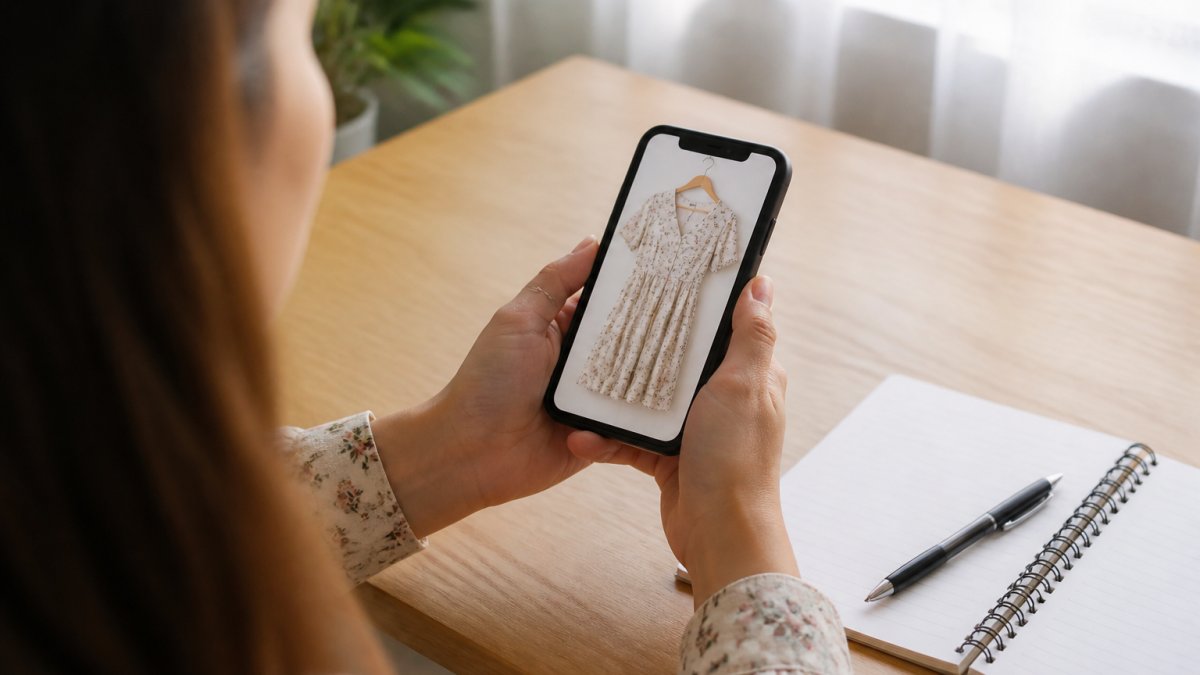
- Zoom in on the photos for seams, hems, and hardware.
- Scan the description for construction words and care instructions.
- Check reviews and the return policy before you add to cart.
It takes about three minutes. That small pause separates a good purchase from a return label.
Read the Fabric Composition and Fiber Content First
Fiber content is the single most useful line on any product page. It tells you how the garment will feel and how it will wash.
Natural fibers like cotton and wool tend to breathe well and soften with wear. Synthetic fibers like polyester hold color and resist wrinkles, but they can trap heat. A blend is not a bad sign; it is a design choice.
Look for a small percentage of spandex in denim or fitted tops. A pair of jeans listed at 94% cotton, 5% polyester, and 1% spandex, like the Trendsi RISEN high rise straight ankle jeans, tells you it is designed to stretch with you.
Zoom In on Product Photos for Stitching and Hardware
Most product photos are shot to flatter. Your job is to look past the styling and find the construction.
Even, tight stitches are a good sign. Sparse, wavy, or wandering lines are not.
Model shots show how a piece drapes and moves. Flat-lay shots show detail. Use both.
Here is the four-step inspection workflow we suggest for every listing, which takes about three minutes.
| Step | What to do |
|---|---|
| 1 | Read the fabric composition before anything else |
| 2 | Zoom in on photos for seams, hems, and hardware |
| 3 | Scan the description for construction words and care instructions |
| 4 | Check reviews and the return policy before adding to cart |
What High Quality Materials for Clothing Actually Look Like Online
High quality materials for clothing show up online as specific, checkable claims rather than vague praise. The trick is knowing which specifications carry real information and which are marketing filler. A listing that names its fiber blend, states a fabric weight, and explains how the piece washes is giving you something to verify. A listing that says only "premium fabric" is telling you nothing.
What Fiber Blends Can and Cannot Tell You
Fiber content tells you how a garment will behave, not how well it was made. A 100% cotton tee can be beautifully constructed or flimsy, and a polyester blend can be durable or clammy.
- Cotton breathes and softens with washing, but it shrinks unless the listing says pre-shrunk or garment-washed.
- Wool regulates temperature and resists odor, but fine merino and coarse wool feel completely different at the same price point.
- Polyester holds color and resists wrinkles, but it traps heat and can pill where friction is high.
- Rayon and viscose drape well but lose strength when wet, so they need gentler washing than the label often implies.
A common pattern is a blend that pairs a natural fiber for hand-feel with a synthetic for durability. That is a design choice, not a red flag.
Fabric Weight and GSM: Useful, but Limited
Fabric weight is usually expressed in GSM (grams per square meter) or in ounces per square yard.
What GSM cannot tell you is fiber quality, stitch density, or how the fabric was finished. A high-GSM fabric can still be loosely sewn.
Watch out: many listings quote GSM only for the body fabric and omit ribbing, lining, or trim, which are often lighter and wear out first.
Terms That Signal Real Specification Versus Filler
- Named fibers with percentages: "95% cotton, 5% spandex" beats "soft cotton blend."
- Named fabric structures: jersey, interlock, twill, poplin, and rib knit each behave differently and are worth searching in reviews.
- Opacity notes: a listing that states whether a white top is sheer is doing you a favor.
- Care instructions: a wash-and-dry guide signals a maker who expects the piece to last.
Take a piece like the Sew In Love geometric short sleeve shirt. The fabric claim is specific, which means you can hold the seller to it. That is how you describe quality of clothes in a way that actually means something.
How to Describe Quality of Clothes Using Labels and Specs
Knowing how to describe quality of clothes comes down to reading three things: the fiber content, the construction notes, and the care label. Together they tell you how a garment is built and how it will age.
The care label matters more than most shoppers think. A piece that says "machine wash cold, tumble dry low" is built for real life.
Clothing Insane Gene HIGH RISE TAPERED JEANS - Premium Quality Product | Fast →
Watch for these red flags in a listing:
- No fiber content listed at all
- Vague phrases like "high quality" with no detail
- No care instructions
- Photos that only show the front of the garment
A listing that hides the basics is usually hiding something else.
How to Know Good Quality Clothes From Seams, Hems, and Hardware
You can often judge a garment by its seams before you ever touch it.
Look for these quality indicators:
- Reinforced seams at stress points like the crotch, underarm, and pocket corners
- Clean seam allowance with no fraying or loose threads
- Even hems that lie flat without puckering
- Secure hardware with smooth zippers and clean buttonholes
Loose threads are a small thing, but they hint at rushed finishing. A maker who skips the final trim often skips other steps too.
You can apply the same eye to the Insane Gene high rise tapered jeans, where durable stitching is part of the listing.
Verify Reviews, Buyer Photos, and Return Policies Before You Order
Reviews and buyer photos are your best evidence of how a garment performs in the real world, but only if you read them like an investigator. Stock photos show the ideal. Buyer photos show the truth, and the review section is where patterns hide.
A Repeatable Review-Verification Method
- Sort by most recent. A five-star review from three years ago may describe a different fabric or fit than what ships today.
- Filter for verified purchases. These are tied to an actual order, which makes them harder to fake than unverified reviews.
- Search the review text for failure words: "shrink," "pill," "fade," "seam," "hole," "returned." Repeated complaints across different reviewers are a stronger signal than any single review.
- Count the pattern, not the average. Ten reviews mentioning pilling after two washes outweigh a 4.6-star average.
- Check review dates against the listing. A sudden cluster of negative reviews can indicate a supplier or fabric change.
Watch out: review sections often mix sizes and colors on one page, so a complaint about a black version may not apply to the white one you are buying.
How to Read Buyer Photos Critically
Buyer photos are useful, but they are not neutral evidence. Lighting, phone cameras, mirrors, and styling all distort color and texture.
- Look for photos taken in daylight rather than under warm indoor bulbs, which shift color.
- Zoom in on seams, hems, and hardware in buyer photos, not just the overall look.
- Compare the buyer photo to the model shot for the same angle; differences in drape and length are real information.
- Treat heavily filtered or staged photos as entertainment, not evidence.
A common pattern is that the most useful buyer photos are the least flattering ones, because they show how the garment actually hangs after a day of wear.
Price the Risk With the Return Policy
Before you add to cart, read the return policy as a cost calculation, not a formality.
- Return window: note the exact number of days and whether it starts at shipping or delivery.
- Who pays return shipping: a "free returns" badge usually means the seller covers it; otherwise, subtract the return cost from the value of the gamble.
- Defect versus fit returns: many policies treat manufacturing defects differently from "didn't like it," so know which category your concern falls into.
- Final sale and clearance: these items often cannot be returned, which raises the stakes on every other check.
Here is a quick verification checklist:
- Search reviews for the words "shrink," "pill," and "wash"
- Confirm the reviews are recent and verified
- Look for buyer photos on real bodies, not just models
- Confirm the return window and who pays shipping
- Check whether the size chart matches the reviews
Reading the photos, reviews, and return terms before you commit is a good habit for any listing.
Shop Love Salve With Confidence: Your Next Step
The gap between a wardrobe that lasts and one that falls apart is usually a few minutes of checking. Read the fiber content. Study the seams.
We built Love Salve around inclusive fashion for every body type, with free shipping and a curated collection so you can find what you need without digging.
Ready to put these checks to work? Browse our collection and see how the details hold up under a closer look.
Frequently Asked Questions
What is the 3-3-3 rule for clothes?
The 3-3-3 rule is a personal wardrobe guideline, not a quality test: wear a new item three times, style it three ways, and decide within three weeks whether it earns space. For online shopping, treat it as a post-purchase check. Before you buy, confirm the clothing quality signs on the listing, then use the first three wears to watch for pilling, shrinkage, or loose threads. If a piece fails early, a 30-day return window like the one on Love Salve denim gives you room to send it back.
How can customer reviews help you judge clothing quality?
Reviews reveal what the product page leaves out: whether fabric pills after washing, if colors fade, and how sizing runs on real bodies. Prioritize verified purchase reviews and buyer photos over star averages. Look for comments about durability, wash well performance, and seam construction. A pattern of complaints about loose threads or shrinkage is a poor-quality sign. On Love Salve, check reviews and buyer photos for plus-size fit feedback before ordering, and use the 30-day return policy if the piece does not match.
What should you check in a clothing return policy before ordering?
Read the return window, who pays return shipping, and whether items must be unworn with tags attached. A 30-day policy is common; shorter windows leave little time to test fit and fabric. Confirm whether sale items are final sale, since those exclusions affect your risk. Love Salve lists a 30-day return policy on its denim products, so you can inspect clothing quality at home and return anything that does not meet expectations without losing money.
How do you check clothing quality before buying online?
Use a four-step workflow: read the fabric composition and care label, zoom into product photos for stitch density and seam construction, scan verified purchase reviews and buyer photos, and confirm the return policy. Check fiber content for high quality materials for clothing, such as a cotton-rich denim blend like the 94% cotton, 5% polyester, 1% spandex on Love Salve's RISEN jeans. Then verify hardware, hems, and finishing details in close-up shots before you add to cart.
The best wardrobes are built one careful choice at a time. If you want clothing that fits well, feels good, and holds up, start with pieces you can inspect and trust. Shop Love Salve for inclusive styles, free shipping, and a collection made for real life.


