













Quick Summary
To layer plus size outfits for winter without bulk, start with a fitted base layer that stays put, then add one thin mid-layer and a coat that skims over it. Thin layers trap warm air, so you stay warm without looking puffy.
- Pick a fitted base top whose shoulder seams sit on your shoulder and whose hem stays tucked.
- Use thin layers instead of one thick sweater, since they trap warm air without adding volume.
- Choose a mid-layer in a light to medium weight that fits under your outer coat.
- Use only one layer to add volume; a chunky knit over a bulky base loses your shape.
- Fit the coat last, over your warmest mid-layer, so the sleeves and shoulders don't strain.
Table of Contents
- Start With a Fitted Base Layer That Stays Put
- How to Layer Clothes Without Feeling Bulky
- Choosing Warm, Breathable Fabrics That Don't Add Weight
- A Temperature-Based Layering Formula for Winter
- Plus-Size Winter Outfit Ideas for Everyday Wear
- Casual Winter Outfits for Plus-Size Women With Boots
- Fitting Your Coat and Choosing Boots That Finish the Look
- Shop the Look: Build Your Winter Layers at Love Salve
- Frequently Asked Questions
Start With a Fitted Base Layer That Stays Put
Winter layering for plus-size women works best when the first layer fits well.
Look for a ribbed mock neck top, because the ribbing holds its shape and hugs your body without clinging. The Cozy Plus Size Ribbed Mock Neck Top 2 is built for exactly this job, sitting close under other layers without adding weight.
What to check before you buy a base layer:
- The shoulder seams sit on your shoulder, not sliding down your arm
- The hem stays tucked when you raise your arms
- The fabric has some stretch so you can move freely
- The neckline sits comfortably under a cardigan or coat
We recommend trying the top on with the bottoms you plan to wear. A base layer that fits your pants and skirts without pulling is the foundation of a good winter outfit.
How to Layer Clothes Without Feeling Bulky
Bulk comes from stacking too many heavy pieces.
Try this simple order from the inside out:
- Base layer: a fitted, thin top that touches your skin
- Mid-layer: a sweater, cardigan, or vest in a light to medium weight
- Outer layer: a coat or jacket that skims over the mid-layer
A common mistake is putting a chunky knit directly over a bulky base.
Keep the outer layer open or unbuttoned when you're indoors. This lets the layers below show, which adds definition and balance to your outfit.
The table below sums up the layering order and the fit trick covered in this section.
| Layer | Role | Key guidance |
|---|---|---|
| Base layer | Fitted, thin top against skin | Keep it close so it stays put |
| Mid-layer | Sweater, cardigan or vest | Light to medium weight |
| Outer layer | Coat or jacket | Skims over the mid-layer |
| Thin layers | Trap warm air | Warm without looking puffy |
| Chunky knit over bulky base | Common mistake | Let only one layer add volume |
| Indoors | Outer layer open | Shows the layers below |
Choosing Warm, Breathable Fabrics That Don't Add Weight
Fabric matters as much as cut. The goal is warmth per unit of thickness: a thin layer that traps air and moves moisture keeps you warmer than a thick layer that traps sweat.
How the main fabrics compare for winter layering:
- Merino wool and wool blends: Warm even when slightly damp, naturally odor-resistant, and thin enough for base and mid-layers. Finer gauges (often labeled lightweight or 200-weight and below for base layers) add warmth without visible bulk. Trade-off: can feel itchy against sensitive skin and usually needs hand washing or a gentle cycle.
- Fleece (polyester): Traps air well and dries fast, making it a strong mid-layer. It is bulkier than a thin knit, so choose a low-pile or microfleece for layering under a coat. Trade-off: can pill and holds static in dry indoor air.
- Thermal knits and ribbed cotton blends: Breathable and comfortable against skin, good for base layers and light mid-layers. Trade-off: cotton holds moisture, so it is a poor choice for the layer closest to skin if you will sweat or get wet.
- Synthetic insulation (polyester fill, PrimaLoft-style fills): Provides warmth with less loft than down and keeps working when damp, which is why it is common in packable coats. Trade-off: less breathable than wool, so it works best as an outer layer rather than against skin.
- Down and down blends: The highest warmth-to-weight ratio, but it loses loft when wet and is usually too warm for indoor-to-outdoor transitions. Best reserved for very cold, dry days.
A practical thickness rule: if a mid-layer is thicker than about a quarter inch when pinched, it will likely show under a fitted coat.
Check the label before you buy:
- A small amount of spandex (often 2 to 5 percent) helps base layers hold shape and move with you.
- Look for flatlock or smooth seams on base layers to reduce chafing under mid-layers.
- For coats, a lining (polyester or satin) helps sleeves slide over sweaters instead of catching.
Care and troubleshooting:
- Wash wool on cold and lay flat to dry to prevent shrinkage that ruins fit.
- Rinse fleece and synthetics less often; over-washing breaks down loft.
- To cut static in dry winter air, add a humidifier or run a dryer sheet lightly over the inside of a fleece mid-layer.
Watch out: buying a mid-layer that is warm but not breathable can leave you damp and colder once you stop moving, so match the fabric to whether you will be active or mostly indoors.
A Temperature-Based Layering Formula for Winter
Dressing for the temperature takes the guesswork out of winter layering. Use this simple formula as your starting point, then adjust for wind, sun, and how warm you run.
Mild winter days (around 40 to 50 degrees F):
- One fitted base layer
- One light cardigan or sweater
- Optional light jacket
Cold days (around 25 to 40 degrees F):
- One fitted base layer
- One warm mid-layer such as a Cozy Turtleneck Sweater Winter Warm
- A structured outer coat
Very cold days (below 25 degrees F):
- One fitted base layer
- One warm mid-layer
- An insulated or fully lined coat
- A scarf, hat, and warm boots
Watch out: piling on bulky layers in very cold weather can restrict movement and make you overheated once you walk indoors. Add layers gradually and remove one when you go inside.
Plus-Size Winter Outfit Ideas for Everyday Wear
Everyday winter outfits should feel comfortable and put together. A simple formula works well: pick one fitted base, one softer mid-layer, and one structured outer piece.
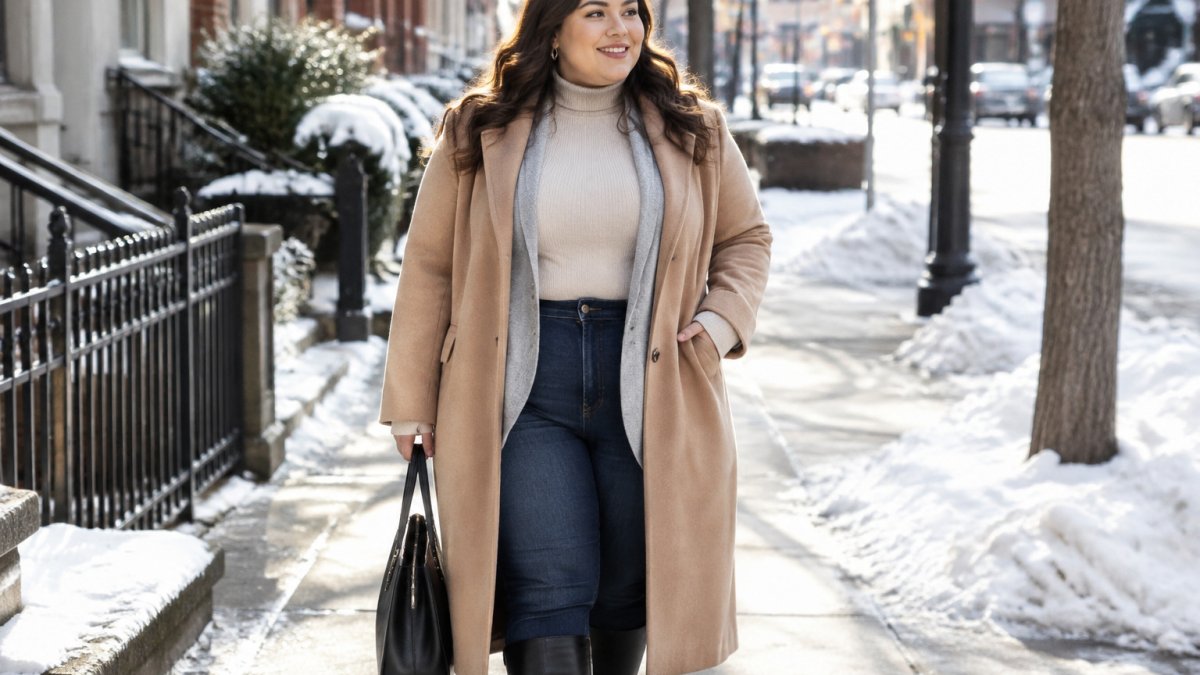
Here are three easy combinations:
- Office look: Fitted turtleneck, Plus Size Plaid Cardigan With Patches open over the top, and tailored trousers
- Weekend errands: Ribbed base layer, cardigan, and jeans with a warm coat
- Night out: Fitted top, long vest, and a dressy wool coat
A plus-size woman in a fitted turtleneck, open-front cardigan, and wool overcoat walking along a sunlit city sidewalk in winter. The mix of textures and the open coat show how layers can look sharp without weighing you down. Stick to one bold piece per outfit so the layers stay balanced.
Casual Winter Outfits for Plus-Size Women With Boots
Boots complete a winter look and can make or break your proportions. Choose boots that fit the width of your calves and sit under or just over the hem of your pants.
Boot tips for plus-size layering:
- Choose wide-calf or wide-width boots if standard sizes pinch
- Wear straight or slightly flared pants so the boot shaft shows the line of your leg
- Keep the boot color close to your pants or a coat shade for a long, clean line
Pair a thin base layer and cardigan with dark jeans and ankle boots for a casual day look. Add a scarf to frame your face and finish the outfit.
Fitting Your Coat and Choosing Boots That Finish the Look
Your coat is the layer that has to fit over everything else, so fit it last and fit it over your heaviest mid-layer.
Coat fit checks by body area:
- Shoulders: The shoulder seam should sit at the edge of your shoulder, not slide down your arm or pull inward. If the seam digs in when you reach forward, size up or choose a raglan sleeve, which gives more room through the shoulder and arm.
- Sleeves: Raise your arms in front of you. Sleeves should cover your wrist without riding up past it. If they pull short, look for a coat with a slightly longer sleeve or a knit cuff.
- Bust and buttons: Button the coat over your mid-layer. The front should lie flat without gaping between buttons. A single-breasted cut with a little stretch in the fabric gaps less than a double-breasted style on a full bust.
- Hips and hem: Sit down in the coat. The hem should not pull tight across your hips or ride up. A coat that ends at mid-thigh or just above the knee gives room to move; a longer hem adds warmth but needs a back vent or a slightly flared cut so you can walk and climb stairs.
- Overall room: You should be able to hug yourself and cross your arms without strain. If you cannot, the coat is too tight for layering.
Matching the coat to your shape:
- If you carry weight through the bust, look for a coat with a defined waist or a belted style so the fabric follows your shape instead of hanging straight.
- If you carry weight through the hips, a coat that skims the hip and flares slightly below it balances the line better than a straight cut that clings.
- If you are tall or long-waisted, check that the waist seam or belt sits at your natural waist rather than above it.
The Full Size Single-Breasted Long Sleeve Overcoat is a good example of a structured outer layer.
Boots that finish the look: Choose boots that fit the width of your calves and sit under or just over the hem of your pants.
- Choose wide-calf or wide-width boots if standard sizes pinch.
- Wear straight or slightly flared pants so the boot shaft shows the line of your leg.
- Keep the boot color close to your pants or a coat shade for a long, clean line.
- Check the heel and sole: a low block heel or lug sole gives grip on ice without pitching you forward.
Finish with a scarf that adds color and warmth. The Knitted Plush Trim Scarf is lightweight enough to layer over a coat, and its length gives you options for looping or wrapping.
Shop the Look: Build Your Winter Layers at Love Salve
Winter layering is easier when each piece has a clear job. Start with a fitted base, add one warm mid-layer, and finish with a coat that fits over both. Use the temperature formula to decide how much to add on any given day.
At Love Salve, we offer plus-size pieces that can be combined into layered looks. Explore our winter collection and pick the pieces that match your everyday routine.
Frequently Asked Questions
What is the 3-3-3 rule for outfits?
The 3-3-3 rule is a quick styling check: pick three pieces that work together, then add three accessories and one more element, such as a bold shoe or a coat, to finish the look. For winter layering, the idea translates well. Keep the base layer and mid-layer slim so the coat can close comfortably. A plus-size cardigan such as the Plus Size Color Block Cardigan adds a visual third piece without stacking extra bulk under your outer layer. Apply the rule to balance proportions rather than to limit how many layers you wear.
How can you layer winter clothes without looking bulky?
Start with a thin, fitted base layer, then add one mid-layer that is not oversized. Choose fabrics with some stretch and drape rather than thick, stiff knits. A relaxed knit like the Trendsi Ribbed Hacci Sweater V-Neck Top keeps warmth without a boxy shape. Finish with an overcoat that skims over your layers. Avoid wearing two bulky pieces at the same time, and keep the longest or heaviest layer on top so the silhouette stays streamlined.
What should you wear under a winter coat to stay warm?
Under a winter coat, layer a fitted base such as a thermal or fine-knit top, then a soft mid-layer like a sweater or cardigan. Keep the mid-layer close to the body so the coat still closes. Lined coats add warmth and help layers glide when you put the coat on. A knitted plush trim scarf adds warmth at the neck without requiring a bulky turtleneck underneath.
What kind of boots work well with plus-size winter outfits?
Boots that work well with plus-size winter outfits are usually mid-calf or knee-high styles that fit comfortably over your leg, plus booties for shorter silhouettes. Look for wide-width or calf-friendly options so the boot does not pull or gap. Pair slim boots with a longer layer like a cardigan or overcoat to balance proportions, and choose a heel or sturdy sole based on how much walking you will do.


